On this blog:
Overview
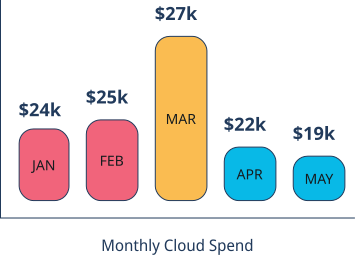
Cloud computing gives organizations the flexibility to scale resources whenever needed, but without proper monitoring and planning, costs can quickly increase. Unlike traditional on-premise infrastructure, cloud environments operate on a usage-based pricing model, making visibility and optimization essential. In this article, we’ll explore practical and simple ways businesses can reduce unnecessary cloud spending while maintaining performance, security, and operational efficiency.
Understanding Cloud Cost Challenges
In an on-premise environment, IT spending is usually predictable. There is an upfront capital investment, and additional expenses require planning and provisioning. In a cloud environment, however, pricing is more dynamic and flexible to match the scalability of cloud infrastructure.
Organizations are charged based on what they provision and use, which is a major advantage. However, this flexibility can also lead to overspending. For example, if someone forgets to shut down a virtual machine or provisions unnecessary resources, cloud costs can increase rapidly. Since cloud platforms offer high elasticity, resources can be subscribed to instantly, making overprovisioning a common issue.
Without proper cost-management practices, cloud expenses can quickly spiral out of control. Let’s look at some simple steps organizations can take to reduce cloud cost sprawl.
Key Challenges in Cloud Cost Management
Cloud pricing is dynamic and usage-based rather than fixed and predictable.
Organizations pay only for the resources they provision and consume.
Unused resources can continue generating costs if not properly monitored.
Virtual machines left running unnecessarily can significantly increase cloud spending.
Cloud elasticity enables instant resource provisioning, making overprovisioning a common challenge.
Resource Optimization
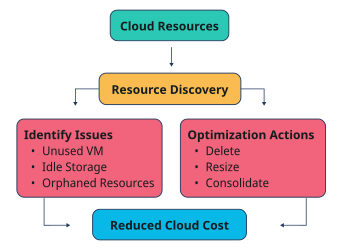
Optimizing workloads and cloud resources is one of the most effective ways to reduce unexpected cost spikes. IT teams should regularly identify abandoned resources, incorrect provisioning, idle instances, and underutilized services.
By eliminating unnecessary resources and optimizing workloads, organizations can significantly improve cloud cost efficiency.
Considerations for Resource Optimization
Detect and remove abandoned or unused resources that continue to incur costs.
Identify incorrectly provisioned resources that exceed actual business requirements.
Monitor idle instances and services that are running without active usage.
Right-size workloads to align resource allocation with actual demand.
Track underutilized resources and adjust capacity accordingly.
Eliminate resource waste to reduce unnecessary cloud spending.
Better Visibility
Achieving cloud optimization requires complete visibility into the infrastructure. This is especially important for large organizations managing extensive cloud environments, where unused or overprovisioned resources can easily go unnoticed.
Improved visibility helps organizations monitor resource usage, identify inefficiencies, and avoid hidden costs as the infrastructure scales.
Detailed Reporting
Many organizations use decentralized systems to manage cloud infrastructure. While decentralization improves flexibility, it can also create challenges when multiple teams or employees manage resources independently.
Detailed reports and real-time dashboards help organizations establish spending rules and monitor sudden cost spikes. Alerts can be configured to notify teams whenever spending deviates from expected patterns.
Tracking licenses, users, departments, and resource ownership also simplifies billing and improves accountability across teams.
Cloud Security
Although cloud security may not directly reduce costs, security incidents can lead to massive financial losses. Even a brief security lapse can expose organizations to cyberattacks, data breaches, and expensive recovery processes.
Investing in strong cloud security practices helps organizations avoid unexpected financial and operational risks.
Adopting Automation and Technology
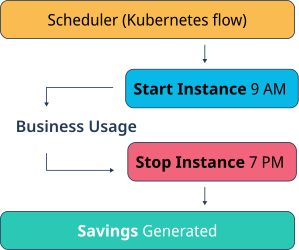
Several cloud management tools help organizations automate cost optimization. For example, some platforms automatically shut down unused resources during non-working hours.
Organizations can also use cloud schedulers such as Kubernetes to start and stop compute resources based on predefined schedules.
While these tools may involve additional investment, they can generate long-term savings through automation, monitoring, auto-scaling, and efficient resource management.
Practice Right-Sizing
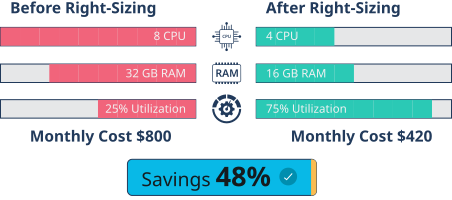
Right-sizing is one of the most effective strategies for avoiding unnecessary cloud expenses. Many organizations overprovision resources to prepare for future growth, which often results in idle or underutilized infrastructure.
By analyzing actual workload requirements, organizations can allocate the right amount of resources, monitor usage trends, and optimize spending more effectively.
Review Cloud Contracts Carefully
Before selecting a cloud provider, organizations should carefully review service agreements, pricing structures, and included features.
Some providers charge separately for features such as security, monitoring, or backup services. Choosing a low-cost provider without understanding the complete pricing structure can sometimes result in higher long-term expenses.
In many cases, selecting a premium cloud vendor with bundled features may provide better overall value and cost efficiency.
Final Thoughts on Cloud Cost Optimization
Controlling cloud costs requires a shift in how IT teams manage infrastructure and operations. Traditional on-premise management approaches are often not suitable for dynamic cloud environments.
To achieve effective cloud cost optimization, organizations must continuously monitor usage patterns, eliminate inefficiencies, implement automation, and establish long-term best practices.
Unexpected cloud expenses are often caused by poor visibility, inadequate planning, lack of automation, and limited understanding of changing cloud consumption patterns. Organizations that proactively optimize their cloud infrastructure are better positioned to improve operational efficiency and maximize the value of their cloud investments.
Key Takeaways for Effective Cloud Cost Management
Eliminating unused or underutilized resources helps reduce unnecessary expenses.
Establishing long-term governance and best practices is critical for sustainable cost management.
Conclusion
Cloud cost optimization is not just about reducing expenses — it’s about using cloud resources more efficiently and strategically. With better visibility, resource optimization, automation, security practices, and right-sizing, organizations can control cloud spending without compromising performance or scalability. A proactive approach to cloud management ensures long-term operational efficiency and sustainable cloud growth.